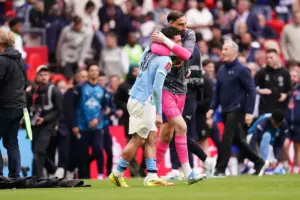

Enzo Maresca faced a wall of VAR questions after City’s derby with Manchester United. Reporters wanted to talk about Erling Haaland’s goal, not City’s performance. The Italian stayed calm, but he made his frustration with the coverage clear from the start.
The headline talking point was obvious. Haaland’s goal stood after officials missed Enzo Fernandez in an offside position, interfering with play. Manchester United were furious, and the story dominated the build-up to Maresca’s press conference.
For the full breakdown of that incident, our coverage of the derby controversy covers the sequence in detail.
Maresca wanted the conversation to include the bigger picture. City had played most of the match with ten men. He reminded everyone that refereeing controversy in this fixture cuts both ways, pointing back to a derby three years earlier that still rankles at the club. His message was simple: judge both incidents by the same standard.
Press conference summary…
Reporters pressed Maresca again and again on the Haaland goal and the offside call before it, but he did not dodge the subject. He addressed it directly, then pivoted to a wider point about balance in officiating over time.
The pattern is now familiar to City supporters, who feel the club’s grievances rarely receive the same hearing.
He reminded journalists that City had suffered a near-identical VAR failure before. In an earlier derby, Marcus Rashford’s offside involvement had set up a Bruno Fernandes goal for United, and Maresca’s tone stayed calm but pointed. He framed the weekend’s incident as part of a pattern, not an isolated injustice against United.
That framing set the agenda for the rest of his answers. Maresca was clear that he did not see the goal as straightforward. He was equally clear that City are still waiting for the apology United received this time.
Enzo Maresca transcript…
Asked about the parallels between the two derbies, Maresca did not hold back, pointing straight to the history.
“I think sometimes it goes for you, sometimes it goes against you. Three years ago when I was here it happened exactly the same against Man United. We lost the derby there.”
He then went further, addressing the lack of any acknowledgement from officials after that earlier incident involving Rashford and Fernandes.
“The goal was not a regular goal. To be honest, no-one apologised We are still waiting for an apology for that goal. Sometimes it happens for you, sometimes against you. It’s football.”
Those comments, first reported by the Manchester Evening News, cut through much of the noise around the weekend’s incident. Maresca was not disputing that Fernandez was offside when Haaland scored. He was pointing out that City had absorbed a similar decision before, without a public correction at the time.
Fernandez’s involvement in the move has itself become a talking point. His importance to Maresca’s midfield keeps growing. Supporters can revisit Enzo Fernandez’s derby performance for context on how influential he has been in this fixture, offside call aside.
City got no correction after the Rashford-Fernandes incident three years ago, and no formal apology followed. Howard Webb apologised to United quickly this time. That contrast makes Maresca’s point about consistency a fair one, even though the two incidents were not handled by identical processes.
The pattern matters to City supporters, who have grown used to defending decisions that go against the club. Maresca’s comparison invites fans to judge both incidents by the same standard.
Post-match reaction…
Maresca’s bigger frustration was not really about the offside call. It was about where the media’s attention had gone, given City had spent most of the second half a player short.
“I’m pleased with the unbelievable performance from the players on Sunday. I’m very pleased with that. And again, talking about one episode or one moment after that game, when we played for 70-75 minutes with 10 players, I think it’s quite poor.”
A red card had left City short-handed for most of the second half. Maresca made significant tactical adjustments to protect his shape against a United side pushing for a winner. Those changes are examined in City’s tactical adjustments after the red card, which explains how the team coped with the numerical disadvantage.
Ten men for the best part of an hour is a serious test for any side. Maresca’s players held their discipline and limited clear chances for United. That context got lost once the offside debate took over.
Maresca returned to the theme of performance over incident when asked to sum up his afternoon.
“I think the performance was unbelievable. I’m pleased with the performance.”
Maresca has a reasonable case. A team playing three-quarters of a match with ten men, and still competing to the final whistle, deserves credit regardless of the result. His frustration was not really about the offside decision. It was about a news cycle that had almost entirely ignored that context.