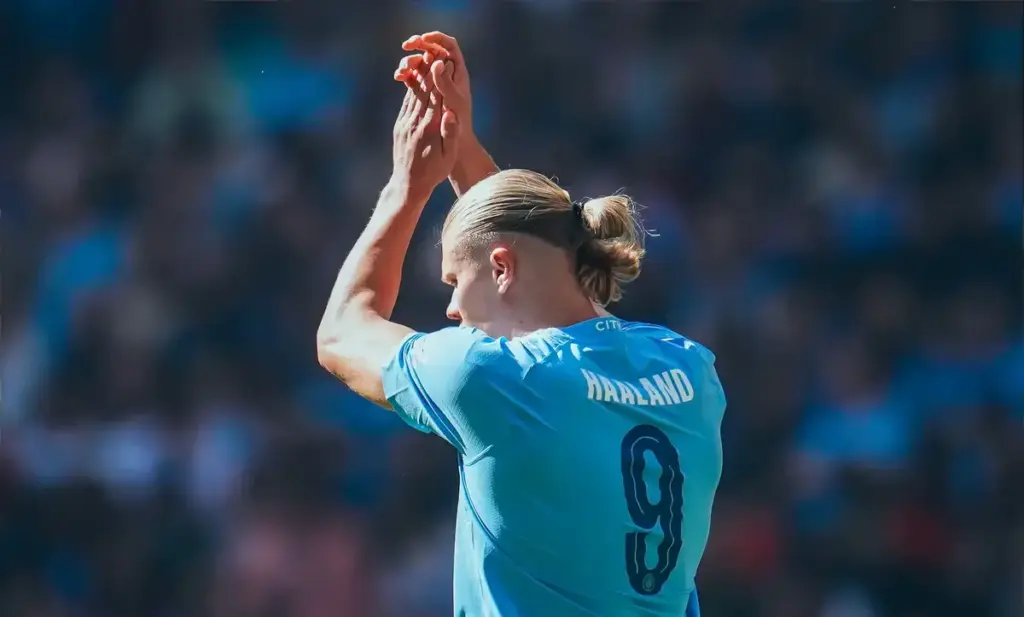

Erling Haaland barely touched the ball for the opening 20 minutes of Sunday’s Manchester derby, yet by full time he was the man who had decided it.
That contrast — a striker who looked almost anonymous for long stretches before producing the moment that mattered most — sits at the heart of what makes him such a uniquely dangerous number nine for City.
The patience behind Erling Haaland’s lethal Manchester derby impact
The Norwegian’s second-half winner extended a remarkable run of form: three goals in his last three Premier League appearances and seven in five games across all competitions. What stood out to those watching closely, though, was not the volume of his involvement but the almost surgical nature of it. Haaland finished the match having had at least 13 fewer touches than any starting Manchester United outfield player, a statistic that would ordinarily invite questions about a forward’s influence. Instead, it became a testament to his efficiency.
Speaking after the match, Haaland was entirely unbothered by the scrutiny his low touch count would inevitably attract in his post-match derby comments.
“People were probably speaking about me barely touching the ball in the first half, and that’s fine,” he said.
It is a level of self-assurance that comes from a player who has spent four-and-a-half seasons proving that involvement and impact are not the same thing.
Beyond touches: The underlying derby figures behind City’s winning goal
The story of City’s winning goal is really a story about patience — about a striker content to stay off the ball, conserve his energy, and wait for the precise moment when the game would open up for him. For long periods of the derby, Haaland drifted along the shoulder of United’s back line, rarely dropping deep to link play and rarely chasing lost causes. His touch map, taken in isolation, tells you almost nothing about the danger he posed.
That approach is by design. Haaland has never been a forward who builds his game around volume of touches; he is built around the moments that follow them. When City finally worked the ball into a dangerous position in the second half, Haaland was there, in the right place, to apply the finish that separated the two sides.
He explained the mentality behind it in blunt terms afterwards.
“I don’t think I touched the ball in the first 20 minutes, but why should I? I didn’t have anything to do. But I have to stay patient and wait for the right moment and when I get the right moment it’s about getting the ball in the back of the net. I managed to do that and I’m happy.”
It is a mindset that flies in the face of conventional wisdom about a striker’s “involvement” in a match, yet it is precisely why Haaland remains the most ruthless finisher in the Premier League. Readers looking for the fuller picture of how the afternoon unfolded, including the VAR controversies following Man City derby win, will find plenty of late drama attached to City’s afternoon as well.
xG, duels and aerial dominance: Dissecting Haaland’s derby efficiency
The numbers behind Haaland’s performance make for compelling reading once touches are removed from the equation. His expected goals figure of 0.87 for the match was the highest of any player on the pitch, underlining that the few chances that did fall to him were genuinely high-quality opportunities rather than fortunate half-chances squeezed out of nothing.
Away from his shooting output, Haaland also asserted himself physically in a fixture that always carries an edge. He won seven of his ten duels and three of his four aerial contests, figures that speak to his willingness to compete even in the periods when the ball was not coming his way. He also completed two of four attempted dribbles and won two fouls, each a small but meaningful contribution to City’s control of the closing stages.
Taken together, these numbers paint a picture of a forward who dictated the terms of his own involvement rather than being dictated to by the opposition. Haaland was not anonymous because United’s defence nullified him; he was selective because that is how he plays his best football. For a broader look at how City’s midfield shaped the contest around him, the derby statistical performance from Sunday’s win offers useful context on how possession and territory were controlled elsewhere on the pitch.
Why Haaland’s supreme efficiency shapes Manchester City’s title charge
What Sunday’s derby confirmed is a broader truth about the current version of Haaland: he no longer needs a heavy volume of touches to define a match. Now in his fifth season in English football, and already past a century of Premier League goals, he has evolved into a striker who conserves his effort across ninety minutes and spends it at exactly the right moment.
That efficiency matters enormously for City as the title race intensifies. A forward capable of producing 0.87 xG from a handful of genuine chances, while still contributing physically in duels and aerial contests, gives City a reliable route to goals even in matches where general play is scrappy or tight. It also reflects well on a player who arrived at this derby with international commitments fresh in the legs, having helped Norway qualify for the World Cup over the summer and reach the quarter-finals.
The debate around Haaland’s touch count will resurface after low-key first halves in future fixtures, just as it has done before. Some will continue to point to speculation surrounding Erling Haaland’s future whenever his form appears to dip even briefly, but performances like this are exactly why City’s long-term plans continue to be built around him.
For a player who scores when it matters most, patience is not a weakness in his game — it is him.



Comments.
Loading comments…