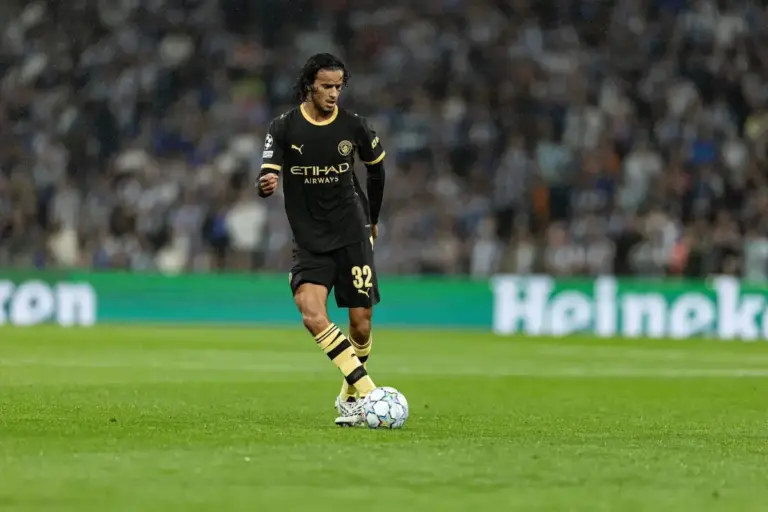

City spent more than any other Premier League club this summer, with the rebuild under Enzo Maresca approaching half a billion pounds. There was also a substantial clearout at the other end.
City broke their transfer record twice.
Elliot Anderson arrived from Nottingham Forest for a reported £116m before Enzo Fernández joined from Chelsea for £125m on deadline day.
Ayyoub Bouaddi, Iliman Ndiaye and Allan Elias were other major additions as the squad was reshaped following Pep Guardiola’s departure.
Rodri, Savinho, Tijjani Reijnders, Nico González and James Trafford were among those sold, while Bernardo Silva and John Stones left on free transfers and Jack Grealish returned to Everton on loan.
Reuters put City’s total summer spending at approximately £458m.
So how does a club spend that much while operating under financial controls?
What City spent
Sky Sports lists the following fees for City’s permanent arrivals:
| Incoming player | Reported fee |
|---|---|
| Enzo Fernández | £125m |
| Elliot Anderson | £116m |
| Ayyoub Bouaddi | £86m |
| Iliman Ndiaye | £65m |
| Allan Elias | £34m |
| Jeremy Monga | £10m |
| Pierce Charles | £3m |
| Gerónimo Rulli | £1.7m |
| Mathys Detourbet | Undisclosed |
Adding Sky’s disclosed figures produces £440.7million.
That is lower than the approximately £458million total reported elsewhere because transfer reporting varies according to whether initial fees, add-ons and other elements of deals are included.
For that reason, around £458million is the better figure to use when describing City’s overall summer expenditure, rather than treating £440.7million as a definitive total.
Either way, it was an extraordinary outlay.
It will not, however, appear as a £458million transfer expense in City’s accounts for one season.
How transfer fees are accounted for
When a player is bought, the cost of his registration is generally spread over the period of his contract through amortisation.
Fernández signed a five-year contract.
Using the reported £125million transfer fee simply as an illustration, straight-line amortisation over five years would amount to around £25million per year.
That does not include his salary, agent costs or other elements which may be relevant to the financial regulations.
Nor does it mean the transfer somehow costs City only £25million.
The club still has to fund the deal.
It simply explains why the accounting treatment of a transfer is different from the headline fee announced in the media.
City sold heavily as well
The rebuild worked in both directions.
Sky Sports lists the following disclosed outgoing fees:
| Outgoing player | Reported fee |
|---|---|
| Savinho | £85m |
| Rodri | £65.4m |
| Tijjani Reijnders | £51m |
| Nico González | £50m |
| James Trafford | £40m |
| Nathan Aké | £8.5m |
| Reigan Heskey | £6m |
| Issa Kaboré | £2m |
| Manuel Akanji | Undisclosed |
| Other permanent departures | Undisclosed/free |
Those disclosed Sky figures add up to £307.9m.
Other published calculations are lower. The Guardian puts City’s outgoing business at approximately £281.8m, while Reuters reported that the club recouped around £280m.
The difference again comes from the way individual deals, bonuses and reported fees are counted.
Rather than claiming an exact figure which the club itself has not published, the safest conclusion is that City generated around £280million or more from sales while spending approximately £458m.
The Guardian’s calculation produces a summer net spend of approximately £175.7m.
Net spend isn’t City’s accounting result
Even that £175.7m figure needs some context.
Net spend is useful for showing the difference between reported buying and selling fees.
It does not show the profit or loss City will record from those transfers.
When a player is sold, his transfer proceeds are compared with the remaining value of his registration in the accounts.
A player developed by the club can have little or no transfer-fee book value, allowing a large proportion of a sale to be recorded as profit.
For a player bought from another club, any remaining unamortised transfer cost has to be taken into account.
That calculation will be different for Rodri, Savinho, Reijnders, González, Trafford and every other departure.
City’s internal book values are not public, so an exact accounting profit from this summer cannot yet be calculated from outside the club.
Selling players has become a major source of income
City have generated large sums from player trading for several years.
Their 2024/25 accounts recorded £95.2m from player sales.
That followed £139m in the previous financial year.
The club’s ability to sell senior players and academy graduates has become an established part of its financial model.
This summer took that process to another level, with several first-team players leaving as Maresca’s squad was rebuilt.
The fees received are only one side of it.
Departures can also remove salaries and future amortisation charges from the squad-cost calculation.
PSR has gone
This is the first Premier League season in which clubs are no longer operating under the Profitability and Sustainability Rules.
PSR was replaced at the beginning of 2026/27 by Squad Cost Ratio and Sustainability and Systemic Resilience rules.
The change moves the focus away from the old three-year permitted-loss calculation and towards the amount clubs spend on their playing operations.
For City, that brings Premier League regulations closer to rules they already encounter in European competition.
How the Premier League’s Squad Cost Ratio works
The Premier League SCR Green Threshold is set at 85% of football-related revenue and net profit or loss from player sales.
Squad costs include player and head-coach wages, transfer amortisation and impairment, and agents’ fees.
The first in-season monitoring takes place in October, followed by the main compliance assessment on 1 March.
A club at or below 85% passes that test without further action.
Clubs begin with additional multi-year headroom of up to 30 percentage points, producing an initial Red Threshold of 115%.
Going above 85% therefore does not automatically lead to a points deduction.
A club that remains above the Green Threshold after the subsequent confirmation process can become liable for a levy, although those levies do not become payable until breaches occurring from 2027/28 onwards.
Using the additional allowance also reduces the headroom available in future seasons through the Premier League’s Feedback Loop.
Going above the Red Threshold can bring a sporting sanction.
City also have UEFA’s 70% rule
Champions League participation adds another set of financial controls.
UEFA’s Squad Cost Rule sets a maximum ratio of 70%.
Its calculation includes relevant employee expenses, player-registration amortisation, loan costs and agents’ fees against adjusted operating revenue and specified player-trading items.
City therefore have to work within both systems.
The Premier League uses an 85% Green Threshold, while UEFA operates at 70% for clubs in its competitions.
They are separate regulations with different calculations and assessment periods, so the percentages cannot simply be compared as though they were identical tests.
But European qualification means City have another financial threshold to satisfy beyond the Premier League’s own rules.
City’s revenue base provides the context
City’s latest published accounts cover the year ending June 2025.
Revenue was £694.1m, the third-highest figure in the club’s history.
Commercial income accounted for £340.4m, broadcasting brought in £278.6m and matchday revenue was £75.1m.
City recorded a £9.9m loss for the year.
Those numbers give some scale to this summer’s activity.
A club generating close to £700m annually starts from a very different position from most of its Premier League rivals when squad costs are measured against revenue.
The wage bill can’t be ignored
City’s transfer fees naturally attract most of the attention, but salaries form a large part of the squad-cost calculation.
The 2024/25 accounts recorded total payroll costs of £408.4m.
That figure covers club employees rather than being a ready-made SCR wage number, so it should not be used to calculate City’s ratio directly.
The squad has changed considerably since those accounts were published anyway.
Fernández, Anderson, Bouaddi, Ndiaye and the other arrivals bring new salary commitments.
Rodri, Bernardo Silva, Reijnders, González, Aké, John Stones and others have gone, while Grealish left on loan.
Assessing the financial effect of the rebuild therefore requires more than adding up transfer fees.
The cost of this summer will run for years
City’s biggest four reported purchases illustrate the point.
Fernández (£125m), Anderson (£116m), Bouaddi (£86m) and Ndiaye (£65m) represent £392m of transfer fees using Sky’s figures.
The annual accounting charge depends on the contracts attached to each deal and the relevant accounting rules.
Those charges will continue beyond 2026/27.
That gives City the ability to spread the accounting cost of the rebuild, but it also commits future seasons to expenditure created this summer.
If another major rebuild were required next year, the existing amortisation charges would still be sitting in the accounts.
Player sales work in the opposite direction
City’s outgoing business helps to balance those commitments.
The club generated around £280m or more in transfer income depending on which published set of figures is used.
Some of those sales should produce accounting profits once the remaining book values of the players are deducted.
Senior departures also reduce future wage commitments.
That combination – high revenue, regular player sales and the spreading of transfer costs across contracts – helps explain how City can operate at this level.
It does not make the spending disappear.
What about SSR?
The Premier League’s new Sustainability and Systemic Resilience rules examine the financial health of clubs away from the squad-cost calculation.
There are three tests: Working Capital, Liquidity and Positive Equity.
For 2026/27, the Positive Equity Test requires a club’s liabilities divided by its adjusted assets to be no more than 90%.
That falls to 85% next season and 80% from 2028/29.
The tests are designed to identify financial problems earlier rather than waiting for losses to accumulate across several years.
They are separate from the SCR calculation.
So what does City’s £458m summer really look like?
It was still a huge investment.
There is no accounting mechanism which changes that.
City spent approximately £458m on transfers according to Reuters and other published estimates, more than any other Premier League club.
The Guardian calculates that around £281.8m came back through outgoing business, producing an estimated net spend of £175.7m.
That is a more useful starting point than the gross spending figure alone, although it still isn’t City’s eventual accounting result.
Transfer costs will be amortised across contracts. Player sales will be assessed against remaining book values. Wages, agent costs and other squad expenditure will feed into the SCR calculations.
City’s revenue base gives them considerable capacity to carry those costs, while their record of generating money from player sales has become an increasingly prominent part of the model.
There are limits.
The Premier League’s new rules apply from this season, and City must also satisfy UEFA’s 70% Squad Cost Rule while competing in Europe.
Maresca has been handed one of the most expensive rebuilds English football has seen.
The headline number is close to half a billion pounds. The financial story underneath it is considerably more complicated.
For updates on City throughout the season, take a look at our LIVE! Premier League 2026/27 News, Transfers, Updates & Viral Moments page.